
This article was first posted to the Capability Lab Substack in June 2026.
Institutions out of time and place
Our systems and models of government often feel anachronistic — not quite built for the demands of the worlds we live in. They are not, of course, because in many cases they are institutions from another century, built to control and preserve, not change and adapt. The gap glares when it comes to government’s relationship with the data-driven technologies that dominate our lives. For the last 15 years, closing that gap has been framed in terms of public efficiency. But today that conversation is bigger than cost savings. It feels more like a critical moment for salvaging the relevance and trust of public institutions to people’s lives.
It’s hard to capture the full extent of what it means to live with governments built in and for another era. Sometimes you see it: an 84-year old senator in charge of a committee on regulating social media. More typically, it’s citizens (usually those with the most complex needs) who experience it, through disjointed services and interventions.
Governments have cultivated particular types of knowledge, reasoning, structures and processes that were suited for a less dynamic and complex world. Certainly, they weren’t built for an age where technological innovations are accelerating and accumulating upon each other. Consider the compounding effects of PCs, the internet and generative AI. Now imagine AI’s impact on future research and innovation, like quantum computing for example.
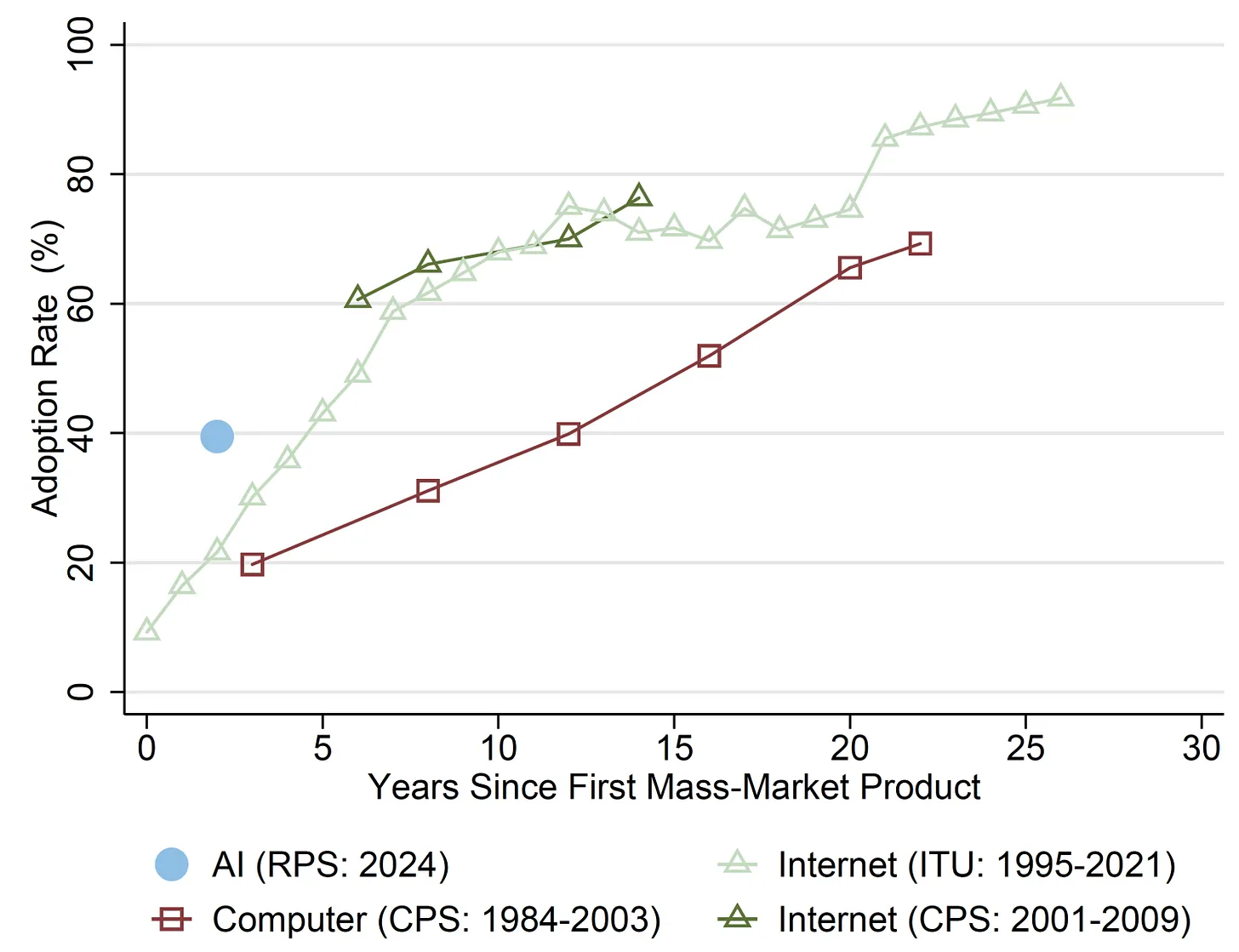
What is the cost of this outdatedness? There’s an efficiency argument to be made about the opportunity cost of not using technology to do things faster and more cheaply. But there’s a subtler risk — less quantifiable, but maybe more profound — about how government itself is perceived by citizens.
Imagine (and it’s not hard) a world where government’s technical capacity and capability falls further and further behind the frontiers of the private sector. At the same time, a winnowing number of technology companies continue to build ever-grander general purpose technologies (operating systems, AI then quantum). These companies are embedded into a widening sphere of state activity, from defence and law enforcement to health, education, identification and perhaps even social security. Policymakers feel compelled to deepen the relationships, because these providers have unique capabilities and their solutions promise to function even better when working with bigger and bigger datasets.
That’s not conspiratorial speculation, but rather a provocation about the democratic implications of living with governments that, frankly, don’t have the capacity to govern — either objectively or instrumentally — the most powerful technologies shaping our lives.
No longer them and us — or “Everything’s computer.”
Most people are alienated from the digital technologies they use everyday. Designers and programmers have excelled at finding ways to make the complexity of machines abstract, to the point, now, where anyone can just speak a product into existence. But convenience has stifled understanding and collaboration — between technologists and everyone else. As a result, institutions, including government, have not been able to transform themselves in the ways they need to; in part because they exist in between two different worlds of language and logic. That change is really hard, especially for governments, but it’s urgently needed if they are to remain relevant.
At some point last year, people couldn’t stop saying “Everything’s computer!” From Spike Magazine to Andreessen Horowitz, it became a clarifying refrain. There are some people who understand this stackable, modular reality intuitively; a handful of companies shape it. The rest of us just wander around with a weary amazement of how everything just works so seamlessly.
The divide between those who “understand computers” and those, to be grossly simplistic, who don’t, manifests as a social phenomena as much as anything else, particularly in the workplace. And it’s in the workplace that we see these two worlds — different language and logic — exist apart from each other. Technical teams are treated as internal suppliers to domain experts, with a growing army of overworked translators trying to communicate back and forth.
The challenge of digital transformation is merging these worlds, closing the gap between the technology on one hand, and the culture, processes and business models on the other. For some governments, the gap between the two can be measured in centuries. And it’s perhaps nowhere more visible than in the constitution of people in government. As a small example, the UK government’s 2025 digital review found that just 10% of departments had a senior digital leader on their executive committee.
It’s easy to imagine how that lack of representation translates into policy, funding, workforce and risk decisions that don’t align with the demands of the tools leaders say they want to use. It’s not hard to imagine how that misalignment cascades through the organisation. But representation is just the start. Transformation demands a degree of integration as well. For government, that may be the hardest challenge of them all.
Integration
Integration is about bringing different organisational worlds together into a unified whole. It’s the difference between building a collection of disconnected professional and social tribes, versus embedding shared purpose and practice. Over the last decade, (some) governments have learned how to do this for the digital era through discrete mechanisms, like multidisciplinary teams. But the underlying structures haven’t really evolved. As a result, the change often feels superficial; highly variable to the particular abilities of individuals and teams, rather than a deeply embedded capability. It’s hard to do, but governments need to build their dynamic muscle; to develop the mechanisms to renew practice in response to massive external forces, like new technological change. Capability frameworks could be such a mechanism.
In a recent paper on how governments might learn to regulate their usage of AI agents, Chris Schmitz and colleagues introduced the diagram below to describe how public agencies might move from “standalone digital governance function… towards centrally coordinated, distributed governance.”
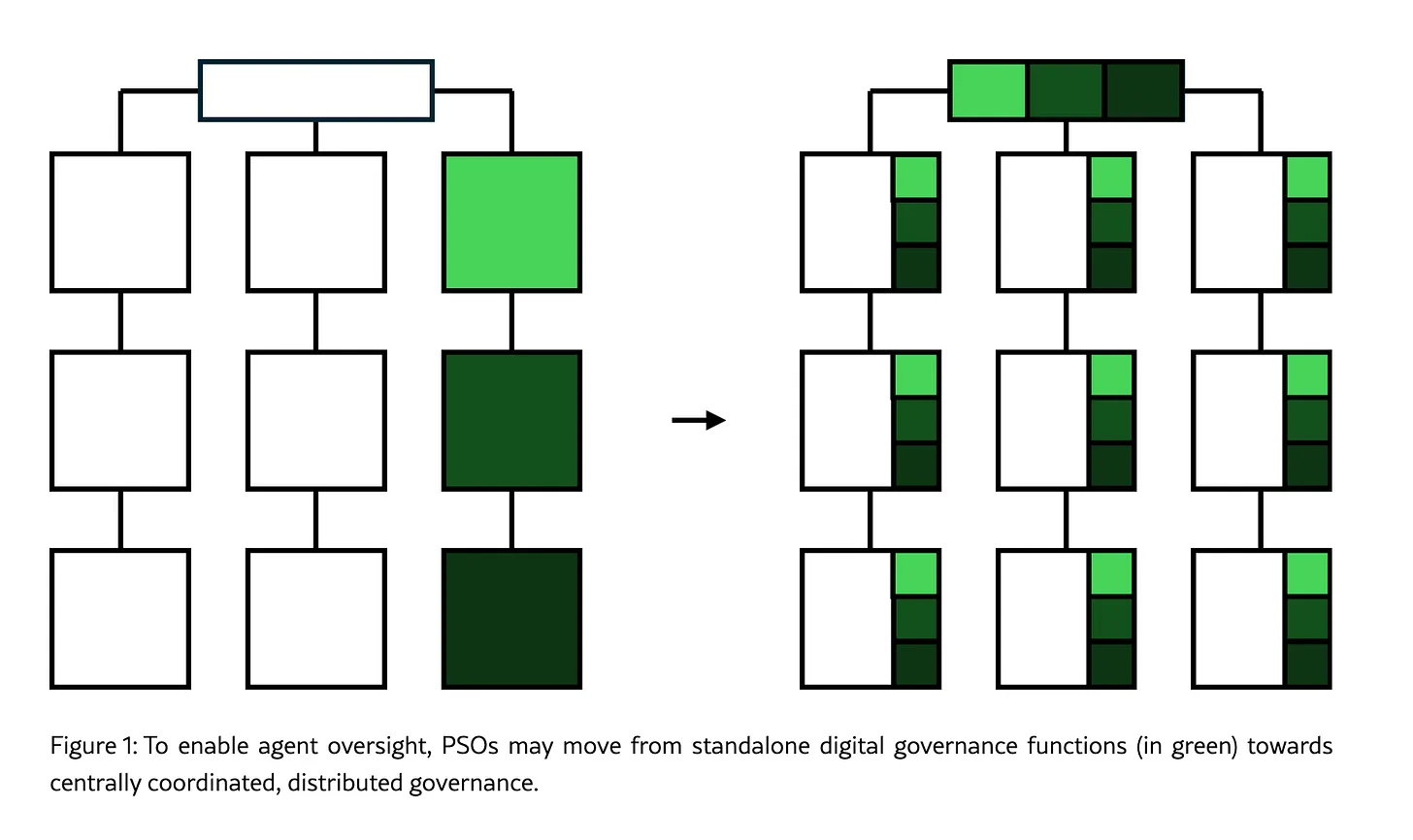
It’s a useful snapshot of the difference between a fully integrated capability, versus one that is siloed and diluted by bureaucratic structures (Schmitz et al., 2025). That integration is about changing the content and logic of every person/team/unit/profession. And that, of course, is why it’s so hard to do.
Mechanisms exist to operationalise this principle, even if they don’t deliver systemic transformation. Multidisciplinary teams, for example, are a standard way of working in several countries. In the context of digital work, they are a mechanism for bringing the full spectrum of perspectives (particularly technical) into the decision-making room as services and solutions are being designed and delivered.
But zoom out from the atomic unit, and consider the bigger picture. If that team is trying to deliver a policy or programme that was developed with little consideration to final implementation, they are left trying to make the best of a difficult situation. Zoom out even further. If they are working in an institution whose strategy, policies and processes are frustratingly misaligned with what they’ve been asked to do, then they have not, to use the parlance, been set up for success.
An old mechanism with new potential
Digital transformation is just one paradigm of a metatrend. The reality is that the world is more dynamic. Innovation happens quickly; society is less homogenous. That means governments — if they are to stay relevant and effective — need to be able to build (and maybe shed) new capabilities in response.
There is a perilously fine line between dynamism and chaos. Hundreds of thousands of people plan their livelihoods around the requirements and progression pathways for their chosen public service profession. Leaders can’t expect people to take change seriously if things are constantly changing.
And yet, this is not the 19th century; governments are not the only ones making the weather. Their job is not just shaping but learning how to respond and keep up; to learn how to flex capabilities at the appropriate scale and speed in response to new opportunities and challenges.
That is where capability frameworks — invigorated by new approaches and technological capabilities — can play an exciting role. Over the coming months, Capability Lab will build on this thesis and demonstrate what it looks like in practice, starting with the specific challenge of strengthening internal digital capability in government.